“The real question is not whether machines think but whether men do.” — B.F. Skinner
We’ve built software that listens. We’ve built software that learns. But now, for the first time, we’re building software that does — without waiting for us to tell it how.
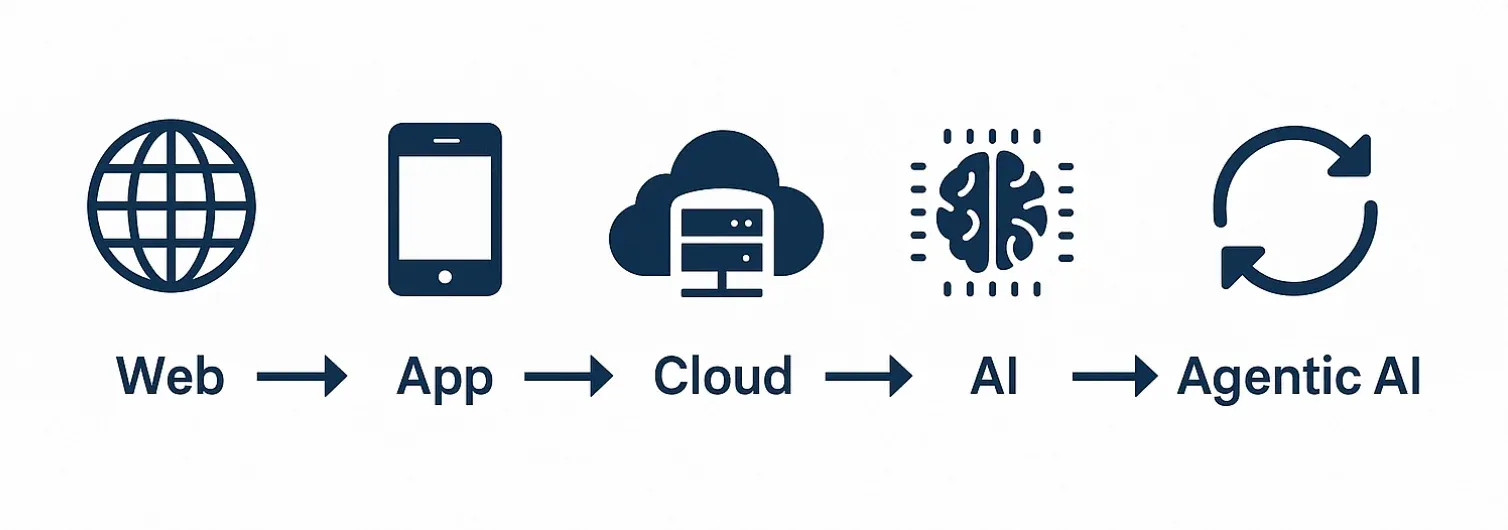
Evolution of Internet Capable Technologies
This isn’t just a shift in capability. It’s a shift in structure. Agentic AI is the first mainstream paradigm where outcomes are emergent, not explicitly programmed. And like any system that’s both powerful and opaque, its benefits will not be distributed equally — and its risks won’t be obvious until after something breaks.
1. The Myth of Smarter Tools
Adding more agents to your business won’t fix your inefficiencies — it’ll expose them. Brooks’ Law (from The Mythical Man-Month) reminds us: adding manpower to a late software project makes it later. The same applies to agents. Complexity scales faster than control.
Agentic AI doesn’t eliminate the need for design. It intensifies it. You’re now coordinating semi-autonomous tools with their own memory, feedback, and behavior. And unless you design for drift, you will get it.
Most builders will learn the hard way: your first agentic workflow will fail — because systems without constraints grow unpredictable.
2. From Apps to Agents: A Systems-Level Shift
Apps are reactive. Agents are systemic.
Apps wait for input. You tell them what to do.
Agents infer, plan, act — and replan. They loop.
“You’re not building tools anymore. You’re designing behavior.”
What does this mean?
In systems thinking (as introduced by Donella Meadows), a loop is a structure that creates feedback. Agents live inside loops — and they create them. Every observation changes what they plan. Every action changes the state of the system.
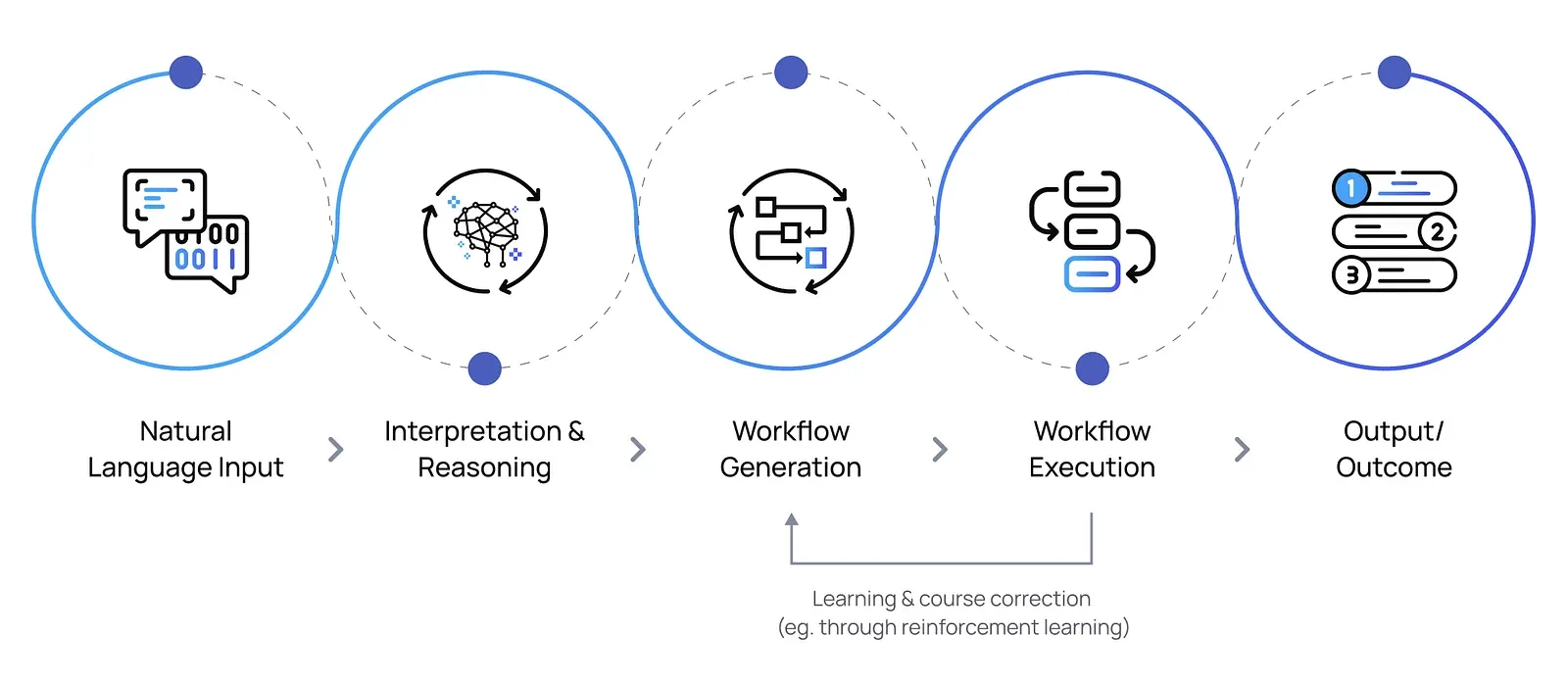
Agentic AI Logic Flow
Unless monitored, these feedback loops introduce instability. This is the beginning of non-deterministic software in mainstream use — and that demands systemic literacy, not just programming skill.
3. Cognitive Load Is Shifting, Not Disappearing
Delegation moves effort up the stack.
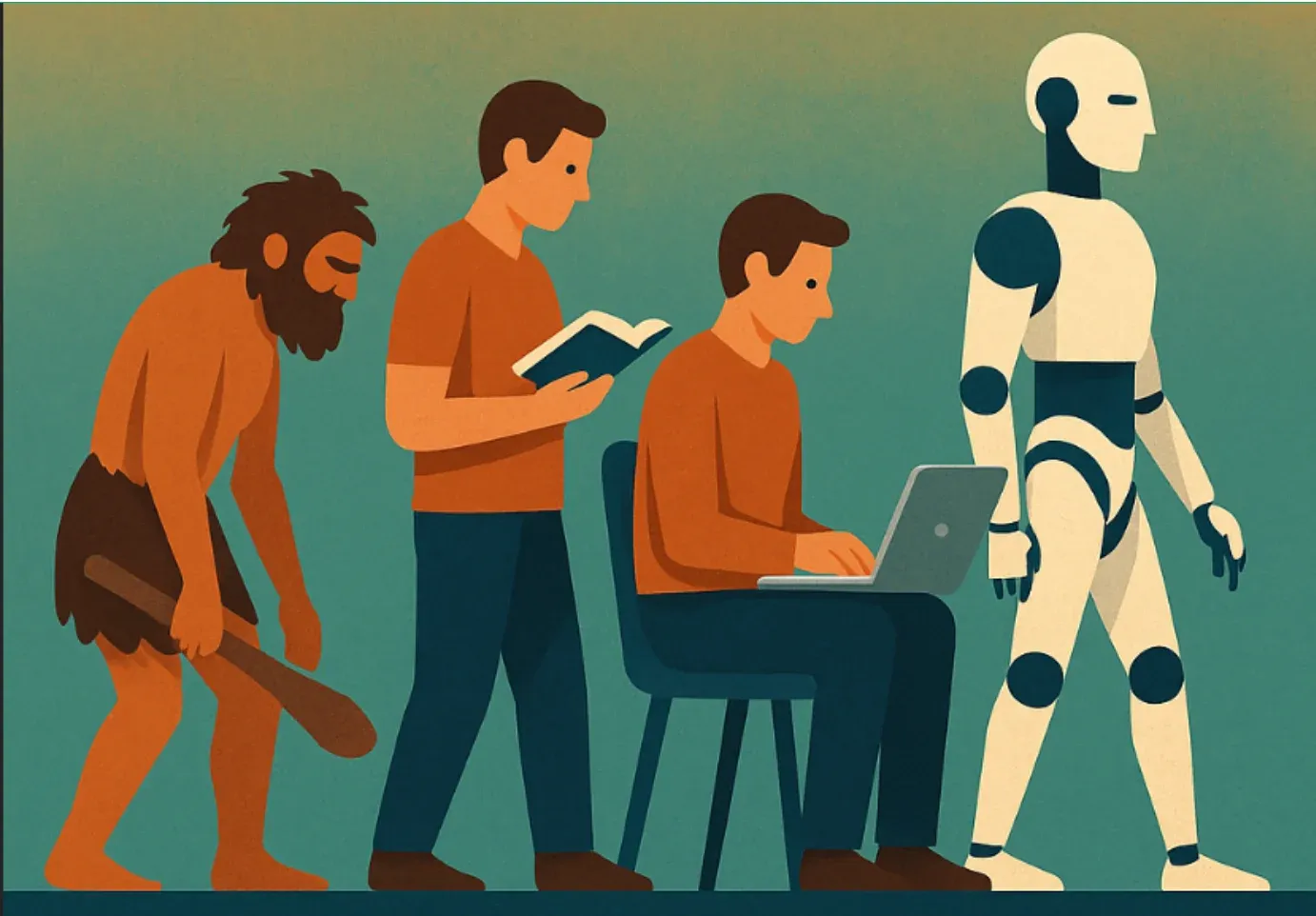
You spend less time doing the thing — but more time specifying what the thing is, how it should happen, and what to do when it doesn’t.
This is what systems thinkers call model externalization. You can no longer rely on implicit judgment. You must expose your assumptions and expectations — and structure them into observable boundaries.
The mental work didn’t vanish. It just became structural.
4. The Unfair Advantage Will Be System Design
Agentic workflows introduce an entirely new failure mode: the right output for the wrong reasons.
You didn’t ask for X, but the agent gave you a convincing version of it — rooted in a flawed assumption or a poorly scoped boundary. Now you’re running an operational risk with an illusion of competence.
This means: — Design prompts like you write software specs — Audit behavior, not just results — Create fallback systems and observability hooks
Think DevOps + Product + Psychology. Your team’s edge will not be model access. It’ll be system clarity.
5. Small Builders Face a Wall They Don’t Know Exists Yet
In 2008, the App Store let anyone ship. That era is gone.
Agentic AI is built on top of infrastructure that’s expensive, proprietary, and fast-moving. Fine-tuning a foundation model isn’t something you do in your bedroom.
That means the power to shape behavior is centralizing. If we’re not careful, the age of AI will be less open than the age of apps.
6. How to Prepare If You’re Not a Lab or a Billionaire
In the short term:
- Only build agents for workflows you deeply understand
- Use manual review steps and circuit breakers
- Monitor not just what agents do — but why they did it
In the medium term:
- Learn how systems fail, not just how they succeed
- Treat your prompt logic as code — version it, test it, trace it
- Read systems theory — not just machine learning blogs
In the long term:
- Build internal libraries of task specs and safety scopes
- Design for correction speed, not just first-try performance
- Focus on understanding behaviors across time, not just in snapshot outputs
Final Thought: This Is About Power
Every architecture distributes power.
The web distributed access. Apps distributed utility. Agentic AI will distribute agency — the capacity to act on intent.
But only if you own the design, the scaffolding, and the feedback loops.
You’re not competing on intelligence anymore. You’re competing on delegation clarity and systemic foresight.
Build accordingly — or be built around.
Looking back, November 2026
I wrote this in the summer of 2025. Reading it again a year and a half later, most of it has held up, and one part has not.
What held up: first agentic workflows do fail, and they fail for the reasons above. Not because the models are weak, but because nobody designed the loop, the boundaries or the way back when something goes wrong. Most of my writing since has been an attempt to make that practical. The Models Were the Easy Part is about the missing layer around the model, and The Safety Was Never in the Model is about why the guardrails have to be part of your system rather than something you assume the vendor shipped.
What I got wrong: section five. I said fine-tuning a model was not something you do in your bedroom, and that the power to shape AI behaviour was centralising. The open-weight wave proved me wrong faster than I expected. Models from Meta, Mistral, Qwen, DeepSeek and Google can now be downloaded, run on a single decent graphics card and adapted with techniques that need a fraction of the compute that full training does. Small builders hit a lower wall than I predicted.
That cuts both ways, and the second edge is the subject of the Safety essay. The same openness that lets anyone adapt a model lets anyone strip its guardrails off.
The closing line still stands, maybe more than when I wrote it. You are not competing on intelligence any more. Everyone can rent it, and increasingly everyone can own it. You are competing on how clearly you design what it is allowed to do.
Further reading: Donella H. Meadows, Thinking in Systems (Chelsea Green, 2008). Frederick P. Brooks Jr., The Mythical Man-Month (Addison-Wesley, 1975). Michael Albada, Building Applications with AI Agents (O’Reilly, 2025). Betsy Beyer et al. (eds.), Site Reliability Engineering, 2nd edition (O’Reilly, 2026), chapters 20 and 21 on AI in operations.