How we lost intentionality to algorithms, and why AI is the same trick with higher stakes.
On October 23rd 2001, Steve Jobs held up a white rectangle and said 1,000 songs in your pocket. That line aged better than most things from that keynote. The iPod held 5GB. Songs were 3 to 5MB. You got a thousand slots. The ceiling forced you to decide.
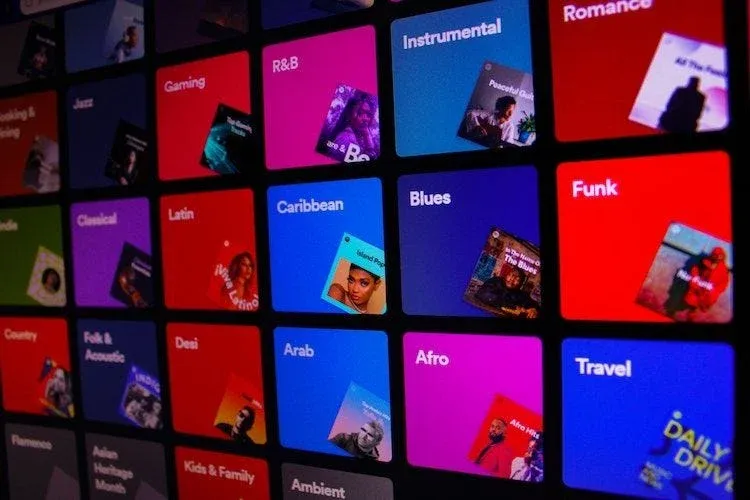
Look at your Spotify home screen. How many of those playlists did you actually make?
Twenty-five years later you have access to a hundred million songs and most people cannot name the last album they chose. They can quote their Wrapped. They can show you the playlist they did not make.
Tim Wu calls this pattern The Master Switch. Every information industry follows the same cycle. Open, centralised, monopolised, disrupted, open again. Telephone. Radio. Film. Television. The internet. It happens every time. Streaming was the last cycle. AI is the next one.
The iPod was a philosophy, not a product
A caveat first. For nearly eighty years before the iPod, the dominant mode of music consumption was radio. Someone in a tower somewhere decided what played. The iPod was not the default. It was a brief anomaly in a century of feeds.
Which is why it mattered.
Getting music onto an iPod was a ritual. You heard a song somewhere. You wrote it down. You went to iTunes and paid 99 cents, or you opened LimeWire and waited twelve minutes for a file that was a virus half the time. You tagged the ID3. You dragged it into a folder. You synced.
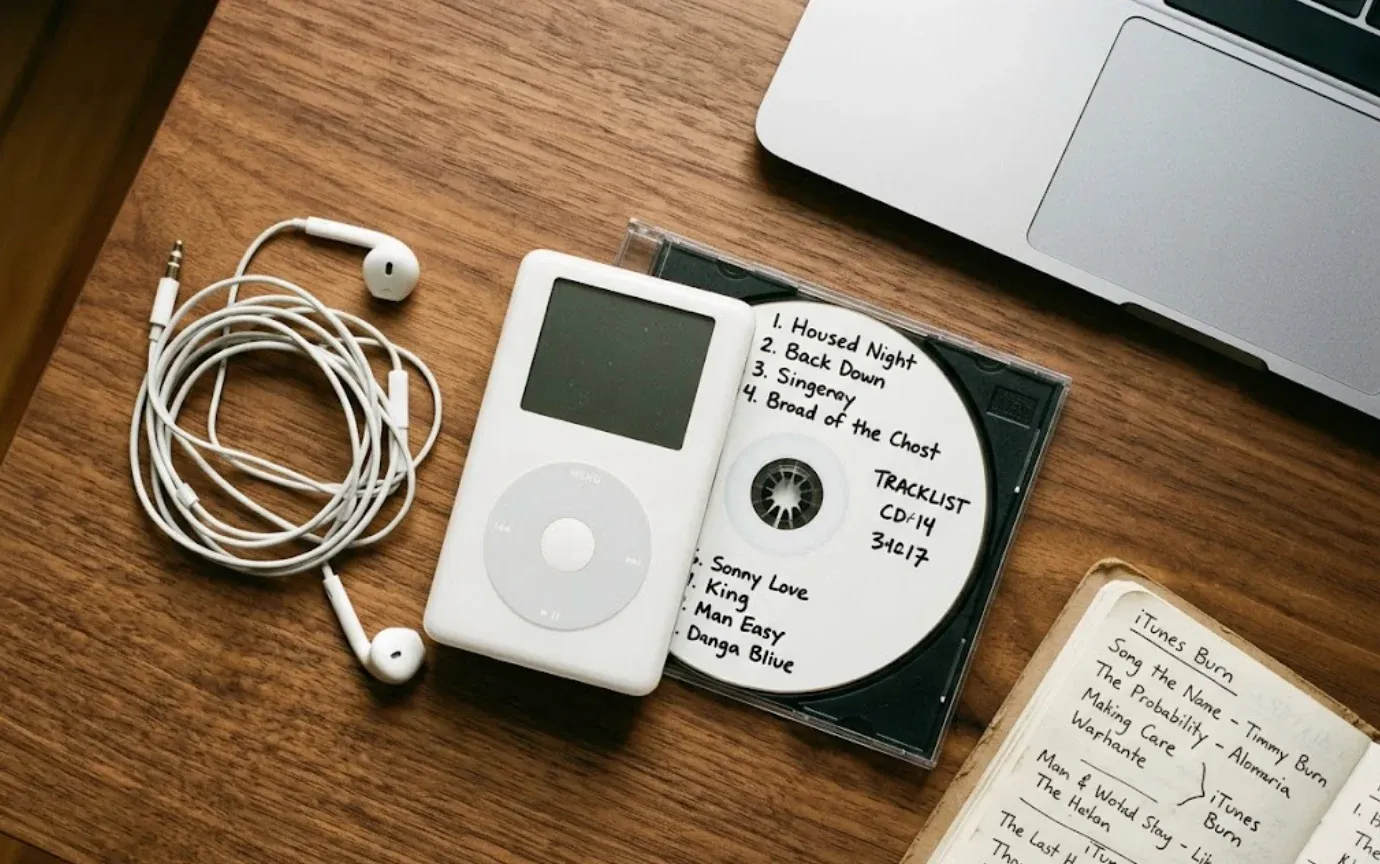
Then, because you only had a thousand slots, you deleted something.
Every add was a commit. Every delete was a commit. Your iPod was a curated self. Hand someone your iPod and in ten minutes of scrolling they knew you. Not because of what an algorithm thought. Because of what you chose.
Jay-Z put it plainly on Diamonds from Sierra Leone:
“I’m not a businessman, I’m a business, man.”
Owning your library made you the business. The iPod was the output. The iTunes library was the asset. The library was sovereign. You could copy it, back it up, take it off the grid, play it in a field with no signal. The music you owned would outlive the companies that sold it to you.
That is gone. Most people under 25 have never owned a song.
Napster was the bridge, not the enemy
The conventional story is that Napster killed the record industry. The honest story is that Napster taught the industry what it would become.
Napster launched in June 1999. By early 2001, 80 million people had used it. Metallica sued in April 2000. They were not wrong. They were early.
Napster did not just make music free. It normalised infinite access. Before Napster, scarcity was the default. After Napster, the only question was bandwidth. The library became the cloud, before anyone called it that.
The record industry fought piracy for a decade and lost. Then in 2008, Daniel Ek and Martin Lorentzon pitched the labels a deal: what if the thing Napster did, infinite access, was legal, and we gave you a cut? The labels, bleeding out, agreed.
Piracy did not lose. Piracy was legalised and sold back to us on a subscription.
The file disappeared.
You do not have a Spotify library. You have an account. When Neil Young pulled his catalogue over Joe Rogan in 2022, albums vanished from users’ “libraries” overnight. When Taylor Swift re-recorded her early albums because Scooter Braun owned the originals, the streaming versions got quietly demoted. You rented access to a catalogue that can be reorganised while you sleep.
The algorithm did not replace the radio.
Streaming did not replace the iPod. It replaced the radio. Then it dressed up the radio as a library, with your face on it.
The first generation of streaming still asked you to choose. You searched. You built playlists. You were still the DJ.
Then Spotify shipped Discover Weekly in 2015. Daily Mix. Release Radar. AI DJ in 2023. Each one took a little more of the decision. By the time TikTok’s For You Page took over attention around 2018, you were not choosing. You were reacting.
The architecture removed the forcing function of decision. You no longer had to commit to a thousand songs. You had all songs. Functionally, you had none. A library you did not build is not a library. It is a feed.
The standard defense is that the algorithm exposes you to things you would not find alone. Yes, and. Engagement-optimised variance is not editorial taste. Blogs, IRC, Pitchfork before it calcified, college radio, mixtapes from friends introduced more genuine novelty than any For You Page, because they optimised for interesting, not sticky. The algorithm does expose you to new things. It just narrows what new is allowed to mean.
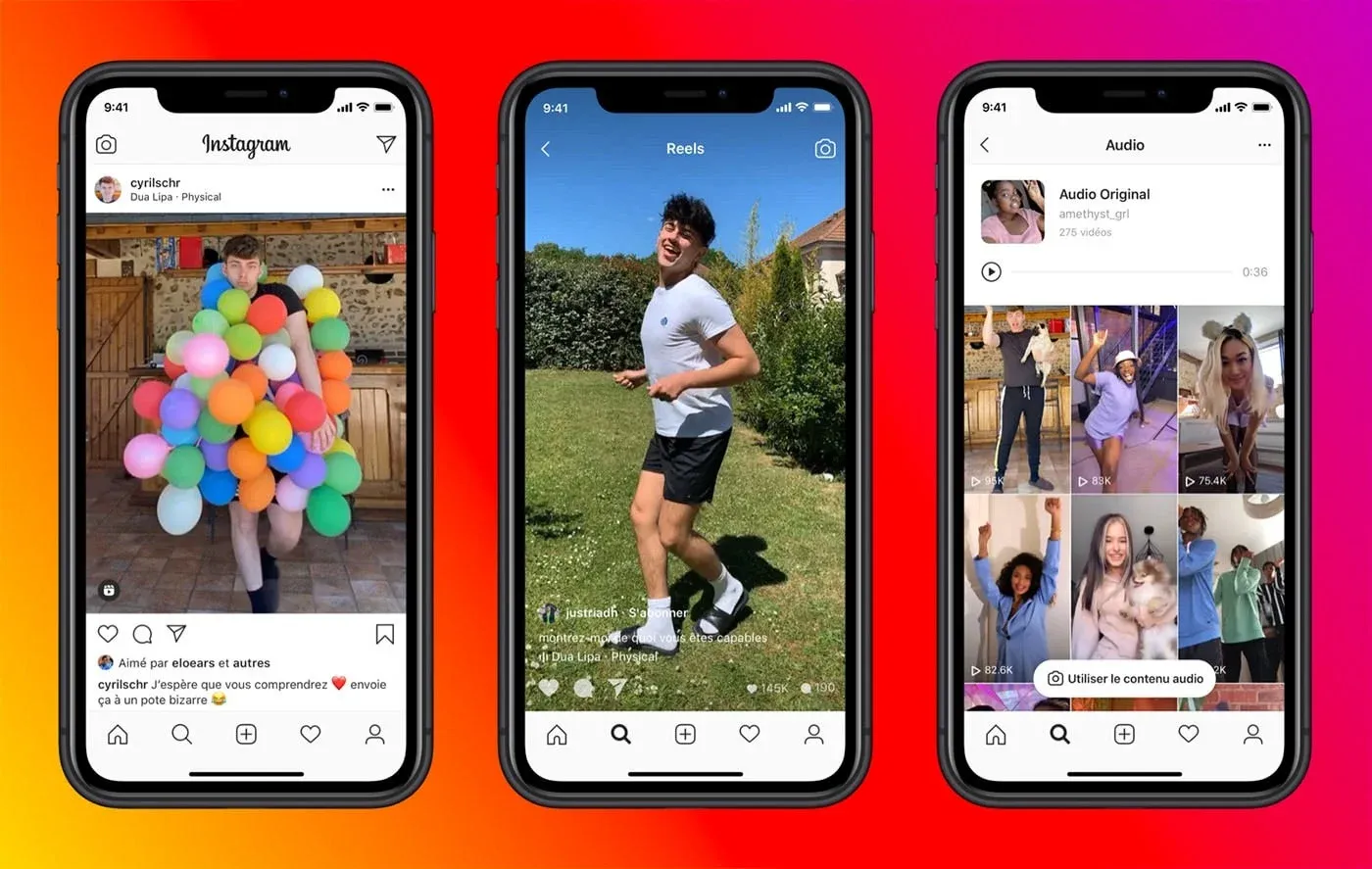
If you want it in black and white, Meta publishes it. Their transparency page for Instagram Reels Chaining, updated November 2025, lists what the system is actually optimising for. Not is this reel good. Not will you remember this in an hour. The first prediction on the list is literally how likely you are to watch less than three seconds of a reel. The rest of the stack is the same shape: how likely you are to reshare, to use the audio in your own post, to follow the author, to click Interested, to watch longer than 95% of users who saw a reel of the same length. The system is not trying to help you find things worth your attention. It is modelling your attention as a probability distribution and optimising for continuation. A Pitchfork editor was trying to tell you what was interesting. Instagram is trying to predict whether you will click off in the next three seconds. Those are not the same goal and they do not produce the same output.
This is not nostalgia, modern streaming has better ergonomics in every measurable way. What got worse is your agency over your own taste. You consume more content than anyone in history and you can recall less of it.
You are what you repeat
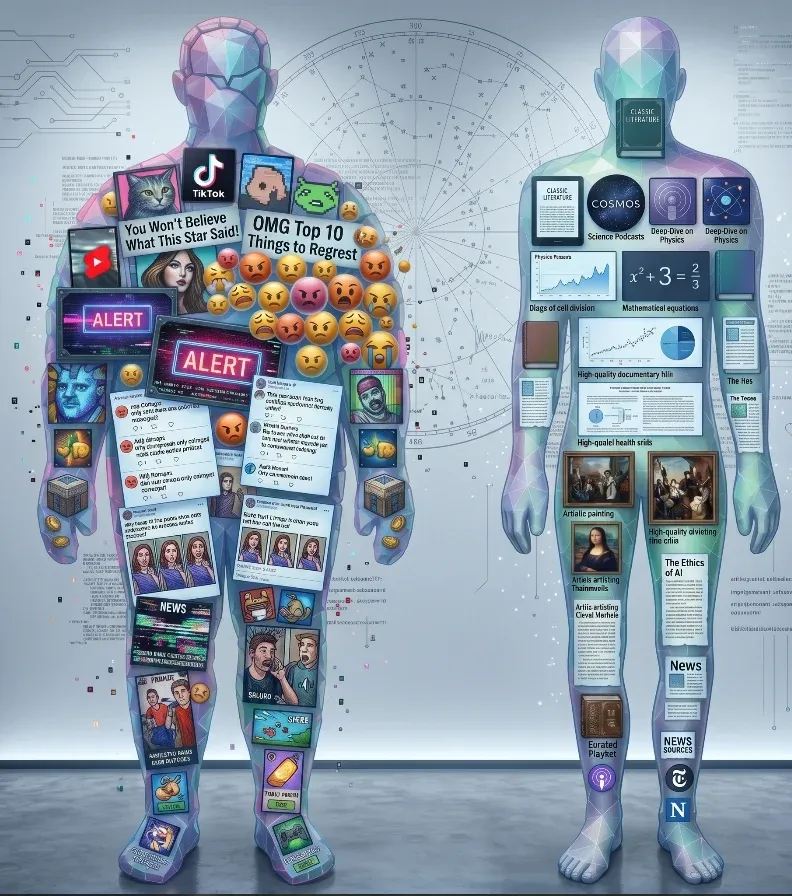
“You are what you eat” is the lazy version. The serious version is that cognition is built from inputs. What you attend to, repeatedly, rewires you.
Daniel Kahneman’s Thinking, Fast and Slow gives us the vocabulary. System 1 is fast, intuitive, pattern-matching, mostly unconscious. System 2 is slow, deliberate. The part of you that actually chooses. System 2 is where identity gets made. It is also lazy by default. It will let System 1 run the show unless you force it awake.
The algorithm is a System 2 bypass.
You do not decide what to hear next, because the feed decides. You do not evaluate, because the feed pre-evaluates. Every scroll, every auto-play, every recommendation trades a moment of cognition for a moment of ease. Stack enough of those and System 2 atrophies.
The algorithm’s job is to convince you otherwise. Sometimes it is right. The problem is that better is measured by engagement, not by whether it made you sharper.
Now the same story, faster
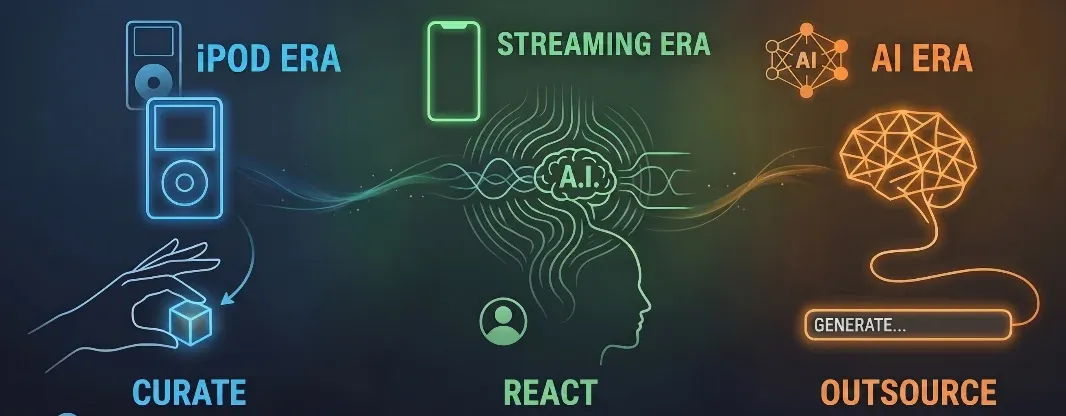
Streaming ate your taste. If the algorithm picks your music, the worst case is you become culturally boring. Bad, but survivable.
AI is coming for your reasoning. Outsourcing your taste makes you a passive consumer. Outsourcing your reasoning makes you redundant. Those are not the same stakes. It is the why in whatever it is you’re doing.
You used to learn by experience + refinement. You had a coding problem. You spent four hours on Stack Overflow. You wrote something bad, then something better. The friction was the feature. The frustration was the mechanism by which the circuit that could solve problems like this actually formed.
Previously LLMs were not at a utility to consumers, outside of researchers and universities in 2018. Then OpenAI shipped ChatGPT in November 2022. Four years later, the default move for any cognitive task is prompt first, think later. Not think and prompt. Prompt, and think only if the prompt fails.
I am not anti-AI. I run small models on my own hardware. I build agents, utilise AI Workflows and architecture. The capability is real. The question is what the use is doing to you.

The obvious objection is the calculator. Nobody thinks we got dumber when we stopped doing long division. The calculator replaced arithmetic and we moved up a layer. Why is AI different?
Two reasons.
Arithmetic has a verifiable answer. Synthesis does not. When you outsource the first draft of a thought, you are not editing toward truth. You are editing toward fluency. Fluency is what the model is trained to produce.
You build that model by writing bad drafts and fixing them. Skip the drafts and you are not editing. You are rubber-stamping a machine that optimises for confidence and encouragement to the user.
The real question is not the model. It is the stack beneath it.
For most of 2022 to 2024, the dominant narrative was scale wins. GPT-4, Claude 3, Gemini Ultra. The frontier was a club of four labs. Peter Thiel’s Zero to One had the script: monopoly is good, plan for monopoly not competition.
Then it broke.
Meta released Llama 2 with open weights in July 2023. Mistral’s 7B landed that September and punched above its weight. Microsoft’s Phi series kept shrinking while performance held. By 2024, a 14B model on a consumer GPU could do what a 175B model did in 2022. In January 2025, DeepSeek’s R1 (open weights, a fraction of the training cost) made the point unmissable. The moat was thinner than the incumbents claimed.
The distinction that actually matters is not small vs large. It is portable vs rented.
A rented/frontier model (GPT-5, Claude via API, Gemini) lives in someone else’s datacentre. You send a prompt, they send a response. If they turn it off, retrain it, raise the price, or decide your use case violates a new policy, you are done. Your workflows break. You are building on rented land.
A portable model (MiniMax, Mistral, Qwen, DeepSeek) runs on hardware you control. Slower. Less capable on the hardest benchmarks. Will not match a frontier model on cutting-edge reasoning today. Currently this with Google’s Gemma4 2B & 4B parameter models are crushing it & with innovations to processing chips, KVM & efficiencies in context, this is only going to get better.
This is not a purity argument. Keep a rented frontier model for the genuinely hard problems. Claude and GPT-5 are better than any 8B at the edge of the capability curve, and that matters sometimes. What it does not mean is that the frontier should be your default. For 80% of knowledge work, a local model handles it and the difference does not touch the output. Portable by default. Rented for the edge cases.
The distinction compounds when you zoom out.
Agentic AI. An agent reads your email, files your tickets, ships your PRs. Every action is a moment of trust. Do you want the agent that runs your life to be a rented process subject to policy changes you do not see? Or running locally, auditable, with weights you can control. Take the plug out & control your data.
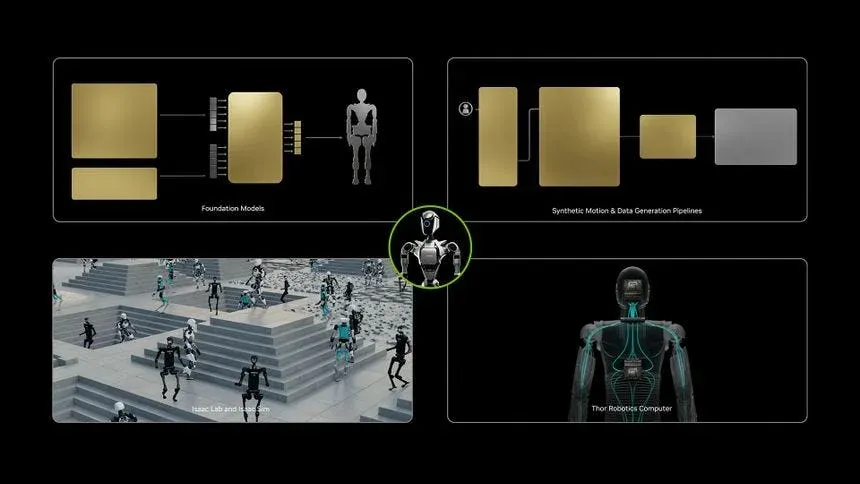
Robotics and action models. Google DeepMind’s RT-2, NVIDIA’s Project GR00T, the broader vision-language-action push. These are AIs that move things in the physical world. A humanoid robot that cannot act without a datacentre roundtrip is a paperweight. On-device models are not a niche. They are the foundation of physical AI.
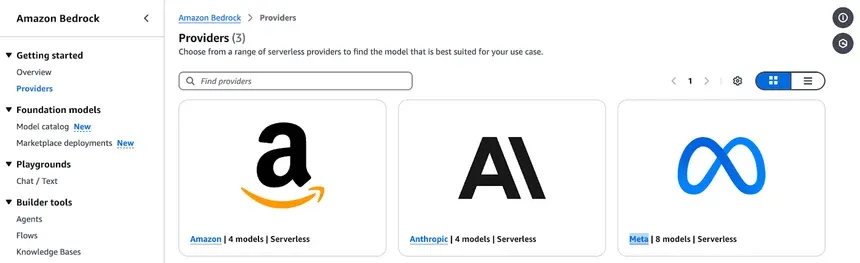
Enterprise. Every serious enterprise in the last year ends the same way. Frontier models win demos. Fine-tuned open models in your VPC win production. Data sovereignty, compliance, cost. All push the same direction.
Entrepreneurship. If you are building on a frontier API you are one pricing change away from your margins vanishing. Every solo dev who built on GPT-3 in 2021 learned this when the terms shifted. The businesses that survive own their stack.
Donella Meadows’ Thinking in Systems names the move. Leverage points. You do not change a system by fighting its outputs. You change it by finding the structural lever where a small shift produces a disproportionate effect. The leverage point here is not use less AI. It is own the stack beneath the AI.
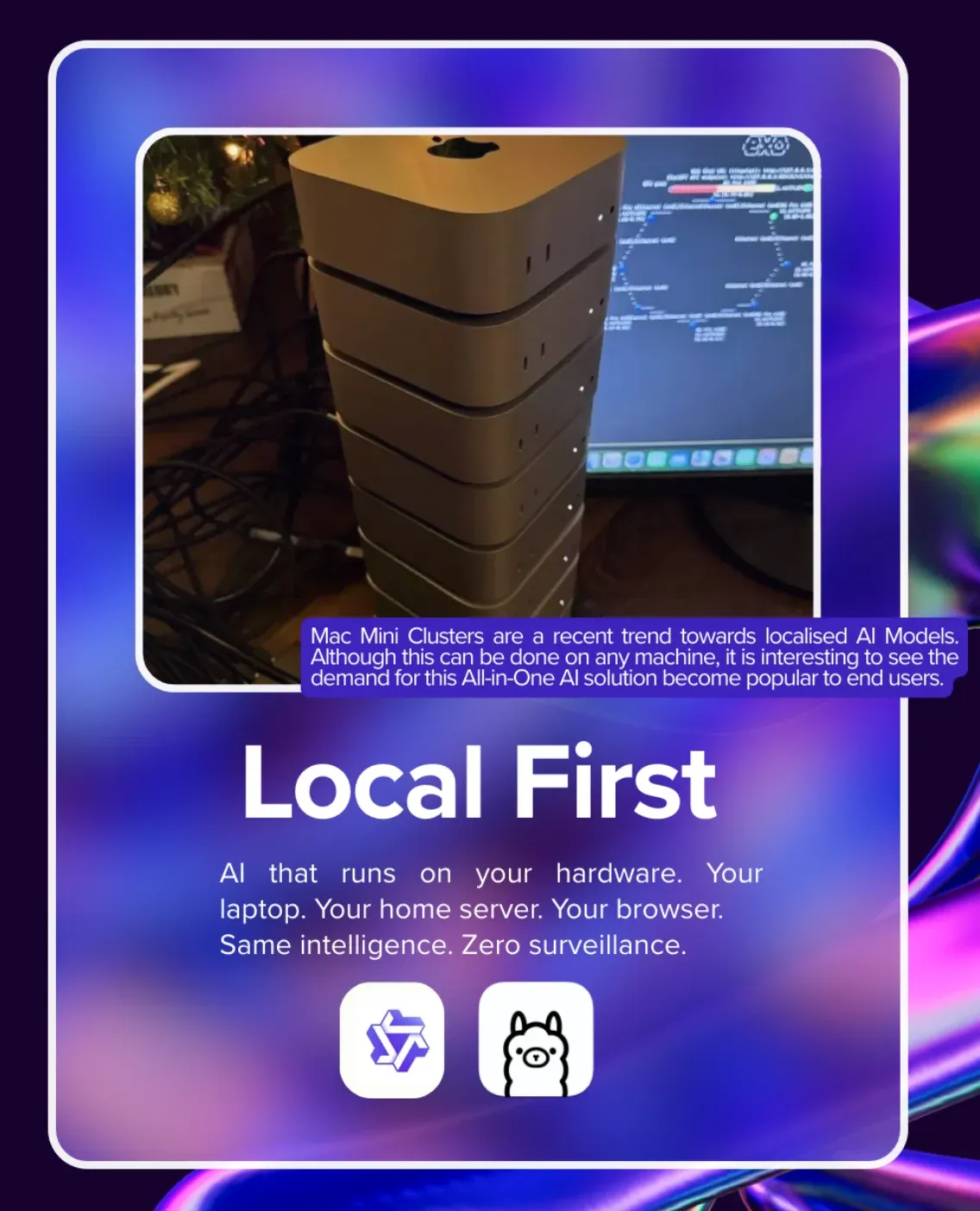
The Graveyard of Convenience
Before you decide convenience is worth it, walk through the graveyard.
Google Reader died in 2013 and took a generation’s RSS habits with it. Evernote’s free tier got paywalled into uselessness. Twitter shut its API in 2023 and killed an ecosystem of third-party clients overnight. Parler got deplatformed at the infrastructure layer and lost its users’ data with no recourse. Every indie dev who built on GPT-3 in 2021 learned the hard way that pricing and terms shift under live products. Zapier, Notion, Figma. Every SaaS you depend on has a pricing roadmap you do not see.
If you do not host it, you do not own it. If you do not own it, you are renting. If you are renting, the landlord can evict you.
The Technical Maturity Model
You do not need a Kubernetes cluster to start. Three tiers. Stop at any of them.
Tier 1. Digital Hygiene. Five minutes.
Open ChatGPT, Claude, and Gemini settings right now. Turn off use my data to train future models. Almost nobody does it. It takes less time than a coffee order. Audit your home screen. Delete one app whose only job is to decide for you. For one task this week, try it yourself for two minutes before you prompt.
Tier 2. Local Inference. An afternoon.
Install LM Studio or Ollama on your laptop. Click to install. Pick a small model like Llama 3.2 or Phi-4. It will not match Claude on the hardest problems. It will handle 80% of your daily prompting and never send a byte to anyone else. Replace one cloud service with a local one. Bitwarden instead of 1Password. Obsidian instead of Notion.
Tier 3. Full-Stack Reclamation. A weekend.
This is the tier where you stop being a consumer of infrastructure and become its operator.
Repurpose an old laptop into a home server. A used HP ProDesk costs less than a month of cloud subscriptions. Install Proxmox. Run Ollama. Expose it to your devices over Tailscale. Now you have a private inference endpoint in your office. No one can turn it off. No one can raise the price. No one can retrain it without telling you.
Self-host the things you use. Jellyfin for media. Nextcloud for files. n8n for the workflows you would have built on Zapier. Vaultwarden for passwords. Each dependency reduced is a piece of your cognitive life that cannot be repossessed.
Stewart Brand said it at the 1984 Hackers Conference:
“Information wants to be free.”
The full quote, less often cited, continues: “Information also wants to be expensive. That tension will not go away.” We are living in the expensive half. The way out is the same as it was in 1984. Build your own tools. Own your own data. Be suspicious of anyone who tells you the convenient thing is also the free thing.